
This page is general relationship and wellbeing writing, not therapy, diagnosis, treatment, crisis support, legal advice, or a safety plan. Use qualified help for persistent distress, trauma, abuse, coercion, threats, self-harm, violence, or urgent safety concerns.
Having boundaries means knowing the limits of what you are willing to share, give, receive or take part in, and making those limits clear enough to act on. A boundary might concern your time, personal space, belongings, money or private information. You can care about someone while having a limit on their access to you.
Start with what the limit actually concerns
Imagine a friend calls while you are getting ready for bed. You want to hear about their day, but you cannot stay on the phone tonight. Your limit might be: “I can talk for ten minutes, then I need to go.” You have described your availability. You have not decided how your friend must feel about it or whether they are allowed to want a longer call.
Stanford Student Affairs describes boundaries as the limits of what is acceptable in relationships. Its guidance moves from reflecting on your needs, to communicating them, to checking whether the arrangement works. That gives the word a practical meaning: notice a specific limit, express it, and choose a workable response. Saying the word “boundary” does not automatically make an arrangement clear or fair.
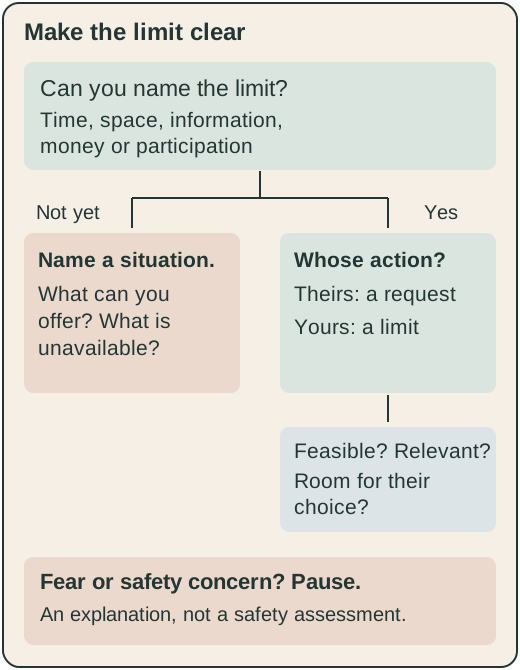
Use the decision guide near the start of this page to think through a sentence. It sorts the next question to ask; it cannot determine whether a relationship is healthy, diagnose a person or decide what is safe. The examples below are invented everyday illustrations, not accounts of tested interventions.
A preference, a request and a boundary can appear together
A preference describes what you would like: “I prefer a quiet evening.” A request asks someone to cooperate: “Would you use headphones?” A personal boundary describes a limit on your participation or access to you: “I am going to read in the other room while the television is on.” These statements can belong in the same conversation. You do not need to choose one label and discard the others.
A request still needs an answer. If someone has not agreed to lower the volume, do not describe that as a broken agreement. You can clarify the request, discuss shared space or take a feasible action. If the room is shared and you cannot leave, your next step may be a practical negotiation rather than repeating a sentence that cannot work in that setting.
For a closer look at that distinction in a partnership, read the difference between a request and a boundary. This introductory guide covers the broader meaning; that page helps with a repeated partner conversation.
What boundaries can look like in ordinary life
Time and availability: “I am not available for a call tonight. I can check whether tomorrow works.” If you do not know your schedule, leave the offer open rather than promising a time you cannot keep. A limit on tonight's call need not become a permanent rule about the friendship.
Personal space and touch: “I would rather wave than hug.” Another person can prefer a hug without being entitled to one. Avoid turning a brief refusal into a debate over whether your reason is convincing enough. You can state the preference directly and choose the form of contact you want to offer.
Information: “I am keeping the details of that appointment private.” You can decide what to disclose about yourself. Shared responsibilities may still require practical information, such as who will collect a child or whether you will be away. Discuss what someone needs to coordinate without assuming that coordination requires every personal detail.
Money and belongings: “I am not lending money, but I can sit with you while you look at the options you already have.” Only offer the second part if you want to and can follow through. A refusal does not need an alternative purchase, gift or unpaid task to become valid. This is an example of wording, not financial guidance.
Across these examples, the useful question is concrete: what access, participation or resource are you deciding about? “Respect me” names an understandable wish but leaves the practical limit unclear. “Please ask before borrowing my headphones; I am keeping them in my bag” identifies the situation more precisely.
Having a boundary does not give you control of the other person
Compare “I will leave this conversation if shouting continues” with “You are not allowed to disagree with me.” The first describes a response you may be able to take. The second tries to remove the other person's choice. Calling either sentence a boundary does not resolve the underlying disagreement.
The wording alone is not enough. Consider whether the action is feasible, relevant to the limit and respectful of other people's choices. A calm voice can still carry a demand for control. Equally, a person may struggle to express a reasonable limit neatly. Read the actual situation rather than awarding points for using the right vocabulary.
Some arrangements need mutual agreement. Shared bills, childcare and work duties cannot always be settled by announcing a personal rule. State the conflict and ask for a workable plan. Stanford also notes that differences in power can affect boundary conversations. A supervisor, dependent family member or partner may have constraints a short script does not address.
When someone else says they have a boundary
Start by understanding what they mean in that particular situation. If a friend says they cannot discuss a topic tonight, you might answer: “Okay. Would you prefer that I leave the topic with you, or ask another day?” They can decline both options. Do not use the follow-up question to keep reopening the conversation they have just ended.
You may feel disappointed and still respect their limit. You can also decide what you are available for. If the proposed arrangement affects a shared commitment, ask about that practical issue separately: “I understand you cannot talk now. We still need to confirm tomorrow's pickup. What way of arranging it works?” You are clarifying the shared task rather than demanding private access.
A boundary does not guarantee that two people's preferences fit. Sometimes the result is a revised plan or a clearer understanding of a disagreement. Neither person has to pretend the conversation solved more than it did.
Turn a vague limit into a usable next step
Choose one situation rather than writing rules for your whole life. Name what is happening in terms someone could recognize. Then identify what you can offer, what you cannot offer and what you will do if the situation continues. Do not add a consequence merely to make the sentence sound firm.
For example: “When a visit runs late, I miss my evening commitments. I can stay until six today, then I will head home.” Check transport and responsibilities before using that line. If leaving depends on someone else driving you, the first task is making an achievable plan. For more help with the emotional part of declining, see a no that does not need a character defense.
Afterward, review what actually happened. Was the limit understood? Was your action possible? Does a shared arrangement need another conversation? You can revise a limit as circumstances change. Revision is more useful when it is explicit, so another person can understand what has changed rather than having to guess.
Keep this guide within its limits
This page is for ordinary relationship pressure. If you fear retaliation, feel unsafe or face threats, do not treat the tool's output as a recommendation to confront someone or leave in a particular way. Seek support appropriate to your circumstances. The tool stops at that concern and does not produce a safety plan.
Source checked on 23 October 2026: Stanford Student Affairs, Trust, Safety, and Respect — The Importance of Boundaries. The definition and reflection, communication and follow-up framework are grounded in that guidance. The distinctions, scenarios, diagram and interactive routes here are editorial teaching aids. They provide no clinical assessment, score, guarantee of a response or replacement for qualified advice.