
This page is general relationship and wellbeing writing, not therapy, diagnosis, treatment, crisis support, legal advice, or a safety plan. Use qualified help for persistent distress, trauma, abuse, coercion, threats, self-harm, violence, or urgent safety concerns.
A useful example of communication in the workplace names a real situation, gives the other person enough context, and makes the next action clear. “Please send the revised figures by 2 p.m. so I can finish the client summary. If that timing is difficult, tell me which figures are still missing” does more work than “Can you sort this out?” It identifies the task, the reason, the timing, and a way to raise a problem.
The examples below are invented teaching scenarios, not transcripts from real teams or evidence of measured results. Change the names, dates, authority and commitments before using them. A sentence that suits a routine project update may be unsuitable for a confidential complaint or a safety incident. Use your workplace's established reporting process for those situations.
What makes the message complete?
Start with an observation that the recipient can check. Add what you need and ask for confirmation where a wrong assumption would matter. A request remains a request until someone accepts it; typing a colleague's name next to a task does not establish an agreement.
The National Association for Court Management's communication reference guide describes communication as an exchange that needs to be understood and open to a response. Its practical guidance includes asking questions, checking meaning, keeping written messages relevant and rereading them before sending. These principles support the examples here; the particular wording and editable template are our editorial work.
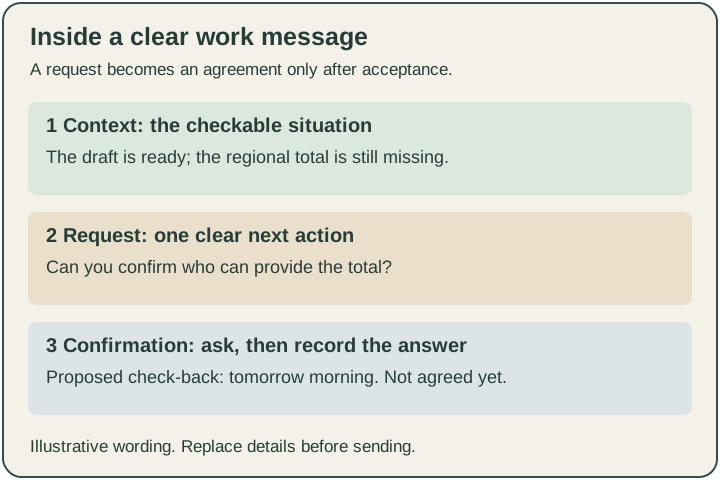
Treat the diagram as a drafting aid, not a rigid formula. A simple acknowledgment can be one line. A complicated handoff may need a conversation and a short written record. The editable template produces a draft for review. It does not send anything or decide whether a recipient has agreed.
1. Clarify a task before starting
Situation: Your manager asks you to “update the report,” but there are two versions and no agreed audience.
Example: “Do you mean the client summary or the internal report? I can update the client summary today. Which version should I use, and who needs to review it before it goes out?”
The useful move is asking about the ambiguity before accepting a task with unclear scope. Avoid stacking unrelated questions into the same message. If the answer changes your workload, make that consequence visible: “If you need both versions today, which other task should move?” That gives the person with authority a decision to make. It does not silently promise extra capacity.
2. Confirm what you heard in a meeting
Situation: A discussion ends with several suggestions but no clear decision.
Example: “My understanding is that we are testing the shorter form first, rather than changing both forms. Have I understood that correctly? If so, who is taking the first draft, and when should we check it together?”
This illustrates active listening through a short paraphrase and a question. It leaves room for someone to correct the interpretation. The CSUN career center's guide discusses clarification and paraphrasing as part of active listening. You can use that principle without copying its wording or claiming that a meeting has reached agreement when it has not.
If a colleague says the decision is still open, record it as open. A meeting note should distinguish a suggestion, a decision and an assigned action. Those are different states, even when they appear in the same discussion.
3. Give a progress update with a real blocker
Situation: You have completed the draft but are waiting for a figure that affects the conclusion.
Example: “The draft is ready except for the regional total. I have marked that section as pending. Could you confirm who can provide the total by tomorrow morning? If it is unavailable, I can send a version that clearly labels the gap for review.”
State what is complete, what is missing and the decision you need. “Almost finished” may leave the recipient guessing whether you need help. Do not invent a confident estimate to make the update sound calmer. If timing is uncertain, explain what determines it and when you can provide another update. Send sensitive figures through the approved channel, rather than pasting them into a wider group chat.
4. Hand work over without assuming acceptance
Situation: A customer question needs another team's input before you leave for the day.
Example: “The customer is asking whether the revised file includes the agreed changes. The file and their question are in the shared ticket. Could you review that ticket and confirm whether you can take the next response? I have not promised a response time to the customer.”
A handoff includes the current state, the location of the relevant information and an explicit request for ownership. Wait for acceptance or follow the team's escalation route. An unread message is not a completed handoff. If you cannot wait, tell the designated cover or supervisor what remains unresolved; do not describe the work as covered unless it is.
5. Give feedback about an observable event
Situation: A shared document was changed after you began preparing the presentation.
Example: “The figures changed in the shared document after I exported the slides, so the two versions now differ. Could we agree on a review point before the next export? I would also like to understand whether there was a deadline I missed.”
Describe the specific event and its effect on the work. Leave out guesses about intent, such as “You never respect my time.” Invite information you might be missing. This draft does not guarantee a comfortable response, and it is not a substitute for a formal process when the issue involves harassment, threats or repeated misconduct.
6. Raise a capacity conflict with your manager
Situation: A new request arrives while two existing deadlines are still active.
Example: “I have the monthly summary and the customer corrections due today. I can start the new request after those, or move one if you want it first. Which priority should I follow?”
Name the actual commitments instead of apologizing for being busy. Offer only options you can carry out. If the request is outside your authority to refuse or reschedule, ask the person responsible to resolve the conflict. For a narrower script, see saying you cannot take on more work. For routine messages outside work hours, use the separate after-hours agreement guide.
Choose the channel before polishing the sentence
A short written message can preserve a task, question or agreed next step. A conversation may be more useful when several interpretations need exploring. Follow it with a brief record if someone will rely on the outcome. For a visual explanation, label the chart's units, period and source, then say what question it helps answer. A chart does not remove the need to check understanding.
Check accessibility and personal preferences rather than assuming everyone can take an unexpected call or interpret a tone of voice the same way. Ask which available channel works for the task. Keep confidential matters within the approved process and audience. The NACM guide cautions against discussing confidential information by email; your organization's rules determine which secure channels are appropriate.
Adapt a message, then check the reply
Use the editable template for a routine clarification, update or handoff. Enter a neutral observation, a specific request and a proposed check-back point. Select whether acceptance is still pending or has actually been confirmed. The output keeps that distinction visible. Blank fields remain marked as missing rather than being filled with invented details.
Before sending, read the draft as the recipient. Can they identify the task without searching through an unrelated thread? Is the proposed date specific enough for your team, including the time zone when relevant? Have you accidentally assigned someone a commitment they have not accepted? Remove private information that does not belong in that channel.
After the reply, update the record. If the person disagrees, note the unresolved question rather than treating the original message as the final answer. If a deadline passes without acknowledgment, use the agreed follow-up route. A clearer sentence is a starting point for an exchange; it cannot create consent, capacity or authority on its own.
Sources and limits
Reviewed on 18 October 2026: NACM, Effective Communication in the Workplace reference guide, especially pages 1–3, and CSUN Career Education, 10 Good Communication Skills in the Workplace, especially its active-listening and communication-type sections. These sources support the general drafting principles. The six scenarios, examples and tool are original illustrations, not validated scripts, workplace policy, legal advice or a promise of a particular response.